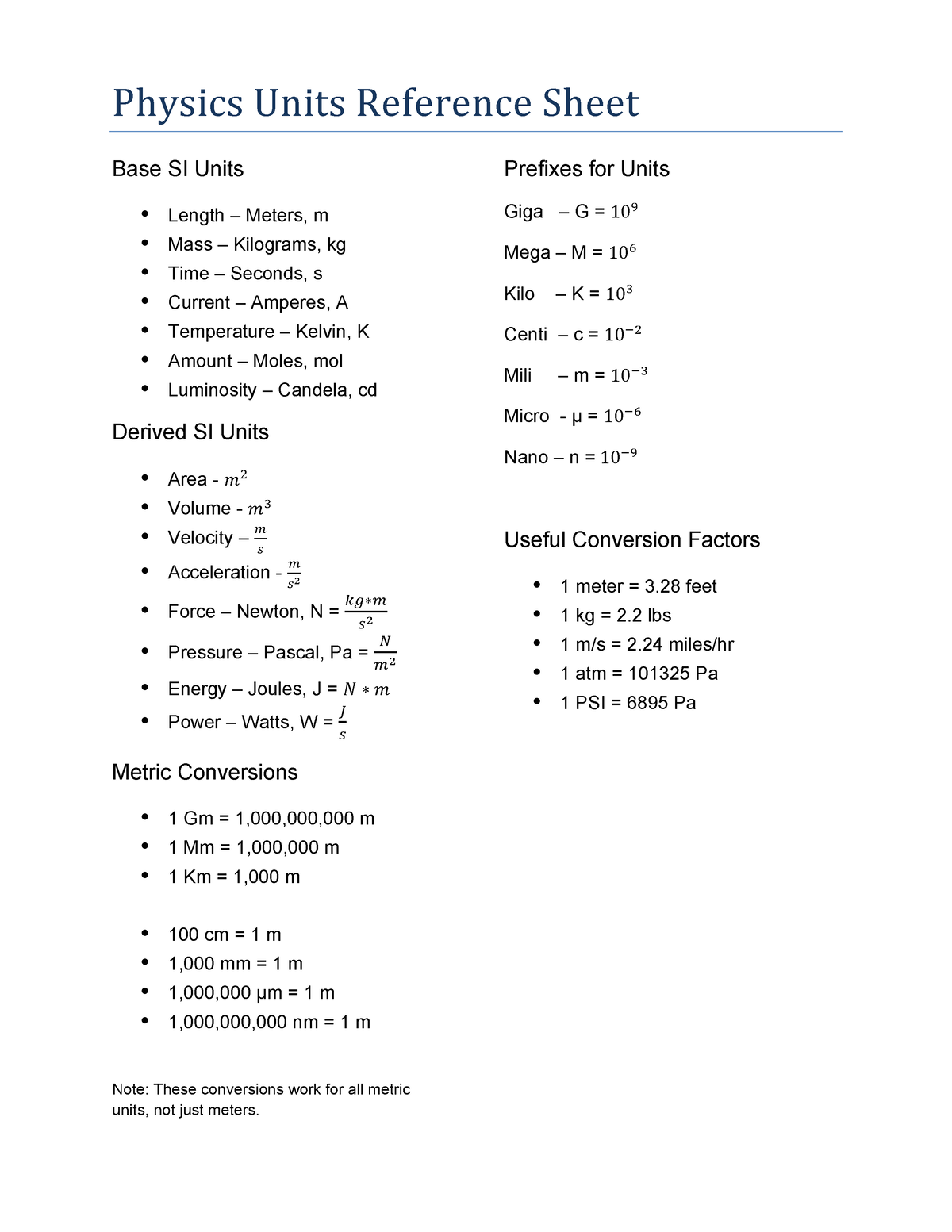

Physics is a fundamental science that seeks to understand the natural world through observation, experimentation, and mathematical modeling. Whether you're a student preparing for exams, a teacher looking for resources, or an enthusiast delving into the mysteries of the universe, having a comprehensive Physics Reference Sheet can be invaluable. This guide will walk you through the essential components of a Physics Reference Sheet, providing you with the tools and knowledge to excel in your studies or research.
Understanding the Basics of Physics
Before diving into the specifics of a Physics Reference Sheet, it’s crucial to grasp the fundamental concepts that form the backbone of the subject. Physics is broadly divided into several key areas, each with its own set of principles and formulas.
Classical Mechanics
Classical mechanics deals with the motion of macroscopic objects, from projectiles to parts of machinery, as well as astronomical objects, such as spacecraft, planets, stars, and galaxies. Key concepts include:
- Newton’s Laws of Motion
- Kinematics
- Dynamics
- Work and Energy
- Momentum and Collisions
Electromagnetism
Electromagnetism is the study of electric and magnetic phenomena and their interactions. It is one of the four fundamental forces of nature and encompasses a wide range of phenomena, from static electricity to the behavior of light. Key concepts include:
- Electric Charge and Field
- Electric Potential and Capacitance
- Magnetic Field and Forces
- Electromagnetic Waves
Thermodynamics
Thermodynamics is the branch of physics that deals with heat and temperature and their relation to energy and work. It is crucial for understanding the behavior of gases, liquids, and solids under various conditions. Key concepts include:
- Laws of Thermodynamics
- Heat Transfer
- Entropy
- Phase Transitions
Quantum Mechanics
Quantum mechanics is the branch of physics that deals with phenomena on very small scales, such as molecules, atoms, and subatomic particles. It introduces concepts that are fundamentally different from those of classical physics. Key concepts include:
- Wave-Particle Duality
- Schrödinger Equation
- Quantum Superposition
- Quantum Entanglement
Relativity
Relativity is the theory developed by Albert Einstein that describes the relationship between space and time. It consists of two interconnected theories: special relativity and general relativity. Key concepts include:
- Special Relativity
- General Relativity
- Time Dilation
- Gravitational Lensing
Creating a Comprehensive Physics Reference Sheet
A well-organized Physics Reference Sheet should include all the essential formulas, constants, and concepts that are frequently used in physics problems. Here’s a step-by-step guide to creating one:
Step 1: Gather Essential Formulas
Start by compiling a list of the most important formulas in each area of physics. These formulas should cover the fundamental principles and equations that are commonly used in problem-solving. For example:
- Newton’s Second Law: F = ma
- Kinematic Equations: v = u + at, s = ut + ½at², v² = u² + 2as
- Work-Energy Theorem: W = ΔKE
- Coulomb’s Law: F = k(q₁q₂/r²)
- Ohm’s Law: V = IR
- First Law of Thermodynamics: ΔU = Q - W
- Schrödinger Equation: iħ(∂ψ/∂t) = Ĥψ
- Einstein’s Mass-Energy Equivalence: E = mc²
Step 2: Include Fundamental Constants
Physics relies on a set of fundamental constants that are essential for calculations. Make sure to include these constants in your Physics Reference Sheet. Some of the most important constants are:
| Constant | Symbol | Value |
|---|---|---|
| Speed of Light | c | 2.998 × 10⁸ m/s |
| Gravitational Constant | G | 6.674 × 10⁻¹¹ N(m/kg)² |
| Planck’s Constant | h | 6.626 × 10⁻³⁴ J·s |
| Elementary Charge | e | 1.602 × 10⁻¹⁹ C |
| Boltzmann Constant | k | 1.381 × 10⁻²³ J/K |
Step 3: Add Useful Conversion Factors
Conversion factors are crucial for solving problems that involve different units of measurement. Include common conversion factors in your Physics Reference Sheet to ensure accuracy in your calculations. For example:
- 1 meter = 100 centimeters
- 1 kilogram = 1000 grams
- 1 joule = 0.239 calories
- 1 newton = 0.225 pounds-force
- 1 volt = 1 joule/coulomb
Step 4: Include Key Concepts and Definitions
In addition to formulas and constants, your Physics Reference Sheet should include key concepts and definitions that are essential for understanding physics. These can range from basic terms to more complex ideas. For example:
- Force: A push or pull acting on an object.
- Energy: The ability to do work.
- Momentum: The product of mass and velocity.
- Electric Field: A region of space where an electric charge experiences a force.
- Entropy: A measure of the disorder or randomness in a system.
- Wave Function: A mathematical description of the quantum state of a system.
- Spacetime: The four-dimensional fabric of the universe, combining three dimensions of space and one dimension of time.
📝 Note: Ensure that your Physics Reference Sheet is easy to read and navigate. Use clear headings, bullet points, and tables to organize the information effectively.
Advanced Topics in Physics
For those delving deeper into the subject, a Physics Reference Sheet can also include advanced topics that go beyond the basics. These topics often require a more sophisticated understanding of mathematics and physics principles.
Quantum Field Theory
Quantum field theory (QFT) is the theoretical framework that combines classical field theory, special relativity, and quantum mechanics. It is used to construct physical models of subatomic particles. Key concepts include:
- Feynman Diagrams
- Quantum Electrodynamics (QED)
- Quantum Chromodynamics (QCD)
- Renormalization
General Relativity
General relativity is Einstein’s theory of gravitation, which describes gravity not as a force, but as a consequence of the curvature of spacetime caused by mass and energy. Key concepts include:
- Einstein Field Equations
- Gravitational Waves
- Black Holes
- Cosmological Constant
Particle Physics
Particle physics is the branch of physics that studies the fundamental constituents of the universe and their interactions. Key concepts include:
- Standard Model
- Higgs Boson
- Quarks and Leptons
- Gauge Bosons
Astrophysics
Astrophysics is the branch of space science that employs the principles of physics and chemistry to ascertain the nature of the heavenly bodies, rather than their positions or motions in space. Key concepts include:
- Stellar Evolution
- Galactic Structure
- Cosmology
- Dark Matter and Dark Energy
📝 Note: Advanced topics can be complex and may require additional resources for a full understanding. Consider including references to textbooks or research papers for further reading.
Practical Applications of Physics
Physics is not just a theoretical subject; it has numerous practical applications that impact our daily lives. Understanding these applications can provide a deeper appreciation for the subject and its relevance.
Engineering and Technology
Physics principles are fundamental to engineering and technology. They are used to design and build structures, machines, and electronic devices. Key applications include:
- Civil Engineering
- Mechanical Engineering
- Electrical Engineering
- Aerospace Engineering
Medicine and Biology
Physics plays a crucial role in medicine and biology, from diagnostic tools to treatment methods. Key applications include:
- Medical Imaging (X-rays, MRI, CT scans)
- Radiation Therapy
- Biomechanics
- Nanomedicine
Environmental Science
Physics is essential for understanding environmental phenomena and developing solutions to environmental problems. Key applications include:
- Climate Modeling
- Renewable Energy
- Pollution Control
- Geophysics
Astronomy and Space Exploration
Physics is the foundation of astronomy and space exploration, enabling us to understand the universe and explore beyond Earth. Key applications include:
- Telescopes and Observatories
- Satellites and Spacecraft
- Rocket Science
- Exoplanet Research
📝 Note: The practical applications of physics are vast and varied. Encourage further exploration by including examples and case studies in your Physics Reference Sheet.
In conclusion, a well-crafted Physics Reference Sheet is an invaluable tool for anyone studying or working in the field of physics. By including essential formulas, constants, conversion factors, key concepts, and advanced topics, you can create a comprehensive resource that will aid in understanding and problem-solving. Whether you’re a student, teacher, or enthusiast, a Physics Reference Sheet can enhance your knowledge and appreciation of the fascinating world of physics.
Related Terms:
- physics reference sheet pdf
- physics formula sheet
- regents physics reference table 2025
- physics reference sheet nsw
- reference table physics 2025
- high school physics reference sheet