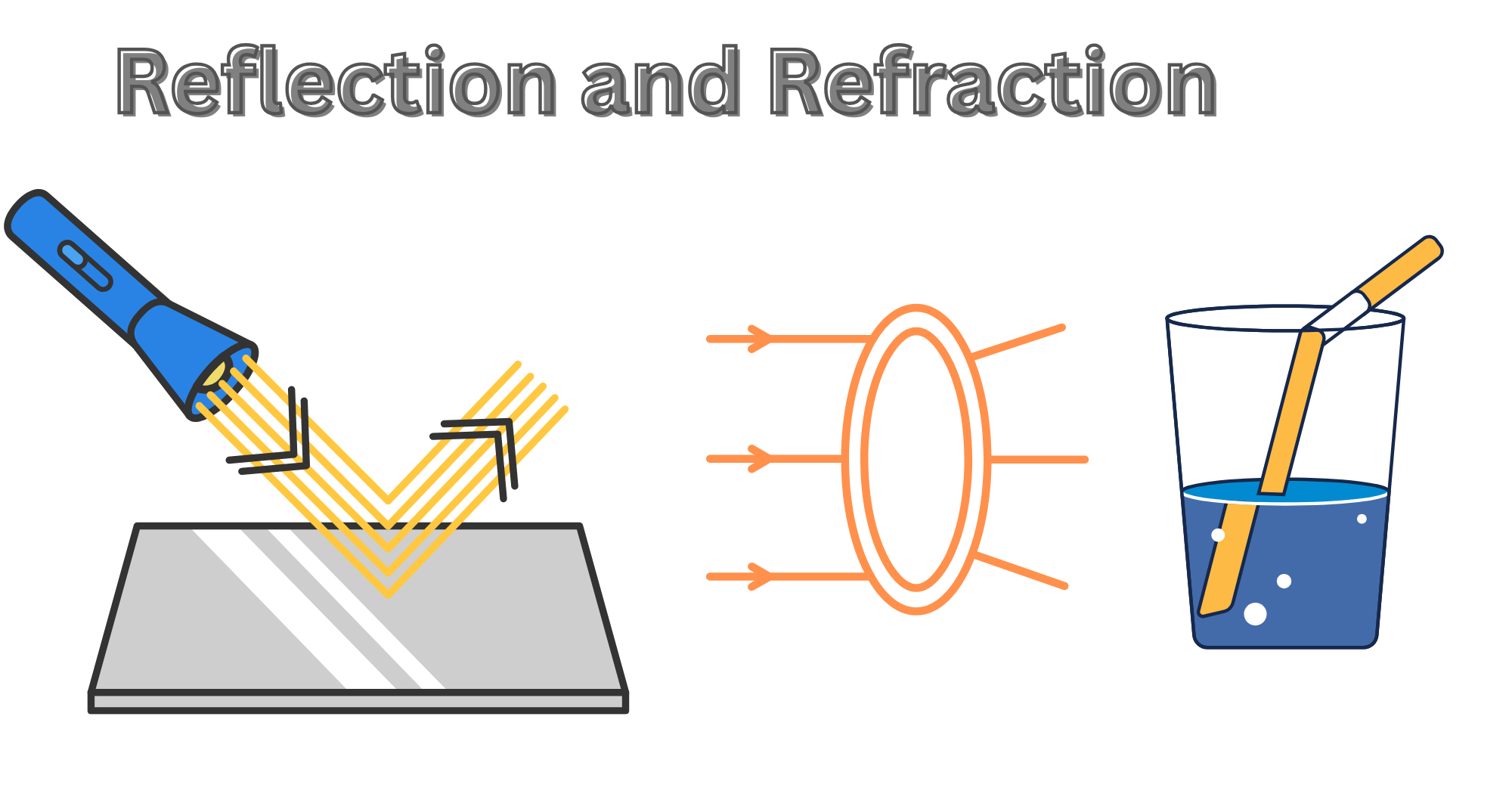

Understanding the principles of *diffraction or refraction* is fundamental to grasping how light behaves when it interacts with different materials and structures. These phenomena are not only fascinating but also have practical applications in various fields, including optics, astronomy, and telecommunications. This post will delve into the concepts of diffraction and refraction, explaining their differences, and exploring their real-world applications.
Understanding Diffraction
Diffraction is the bending and spreading of waves when they encounter an obstacle or pass through an aperture. This phenomenon is most noticeable when the size of the obstacle or aperture is comparable to the wavelength of the wave. Diffraction is a wave property and occurs with all types of waves, including light, sound, and water waves.
When light waves encounter an obstacle, such as a sharp edge or a narrow slit, they bend around the edges and spread out. This spreading is known as diffraction. The amount of diffraction depends on the wavelength of the light and the size of the obstacle or aperture. Shorter wavelengths diffract less than longer wavelengths, and smaller apertures cause more diffraction than larger ones.
Diffraction can be observed in everyday life. For example, when you look at the edge of a shadow cast by a sharp object, you might notice that the edge is not perfectly sharp but slightly blurred. This blurring is due to the diffraction of light waves around the edges of the object.
Understanding Refraction
Refraction, on the other hand, is the bending of light as it passes from one medium to another. This occurs because light travels at different speeds in different materials. When light enters a denser medium, such as water or glass, it slows down and bends towards the normal (an imaginary line perpendicular to the surface). Conversely, when light exits a denser medium and enters a less dense medium, such as air, it speeds up and bends away from the normal.
The amount of refraction depends on the refractive index of the materials involved. The refractive index is a measure of how much light slows down in a material compared to its speed in a vacuum. Materials with a higher refractive index cause more refraction than those with a lower refractive index.
Refraction has many practical applications. For example, lenses in cameras, eyeglasses, and telescopes use refraction to focus light and form images. Prisms use refraction to separate white light into its constituent colors, creating a spectrum.
Key Differences Between Diffraction and Refraction
While both diffraction and refraction involve the bending of light, they occur under different conditions and have distinct characteristics. Here are some key differences:
| Aspect | Diffraction | Refraction |
|---|---|---|
| Cause | Occurs when waves encounter an obstacle or pass through an aperture. | Occurs when waves pass from one medium to another with different densities. |
| Dependence on Wavelength | More pronounced for longer wavelengths. | Dependent on the refractive index of the materials involved. |
| Direction of Bending | Waves bend around the edges of the obstacle or aperture. | Waves bend towards or away from the normal depending on the medium. |
| Applications | Used in diffraction gratings, single-slit experiments, and the design of optical instruments. | Used in lenses, prisms, and optical fibers. |
Understanding these differences is crucial for applications in optics and other fields where light behavior is manipulated.
Applications of Diffraction
Diffraction has several important applications in science and technology. One of the most well-known applications is in diffraction gratings. A diffraction grating is an optical component with a periodic structure that splits and diffracts light into several beams traveling in different directions. This property is used in spectrometers to analyze the spectral composition of light.
Another application of diffraction is in the design of optical instruments. For example, the resolution of a microscope or telescope is limited by diffraction. The smaller the aperture of the instrument, the more significant the diffraction effects, which can blur the image. Understanding and mitigating diffraction is essential for improving the resolution of optical instruments.
Diffraction is also used in X-ray crystallography, a technique used to determine the atomic and molecular structure of a crystal. When X-rays are diffracted by the crystal lattice, they produce a pattern that can be analyzed to deduce the structure of the crystal.
🔍 Note: Diffraction patterns can provide detailed information about the structure of materials at the atomic level, making it a powerful tool in materials science and chemistry.
Applications of Refraction
Refraction has a wide range of applications in optics and telecommunications. One of the most common applications is in lenses. Lenses use refraction to focus light and form images. Convex lenses, for example, converge light rays to a focal point, while concave lenses diverge light rays. This principle is used in cameras, eyeglasses, and telescopes.
Prisms are another important application of refraction. Prisms use refraction to separate white light into its constituent colors, creating a spectrum. This property is used in spectroscopy to analyze the composition of light sources. Prisms are also used in binoculars and periscopes to change the direction of light.
Optical fibers use refraction to transmit light over long distances with minimal loss. Light is confined within the fiber by total internal reflection, a phenomenon where light is completely reflected back into the fiber when it hits the boundary at a certain angle. This property makes optical fibers ideal for high-speed data transmission in telecommunications.
📡 Note: Optical fibers are the backbone of modern telecommunications, enabling high-speed internet and data transmission over long distances.
Real-World Examples of Diffraction and Refraction
Diffraction and refraction can be observed in various real-world phenomena. For example, the rainbow is a result of both diffraction and refraction. When sunlight enters a raindrop, it is refracted and separated into its constituent colors. As the light exits the raindrop, it is diffracted, creating the characteristic bands of color.
Another example is the mirage, a phenomenon where light is refracted by layers of air with different temperatures. This causes objects to appear displaced or distorted, creating the illusion of water on a hot road or desert.
In astronomy, diffraction and refraction play crucial roles in the design of telescopes. The resolution of a telescope is limited by diffraction, while refraction is used to correct for aberrations and improve image quality. Understanding these phenomena is essential for designing and operating telescopes that can observe distant celestial objects with high precision.
In telecommunications, diffraction and refraction are used to design and optimize optical fibers and other components. For example, diffraction gratings are used to multiplex and demultiplex signals in fiber-optic communication systems, allowing multiple signals to be transmitted over a single fiber.
In medicine, diffraction and refraction are used in various diagnostic and therapeutic applications. For example, X-ray diffraction is used to analyze the structure of biological molecules, while refractive surgery is used to correct vision problems by reshaping the cornea.
In environmental science, diffraction and refraction are used to study the properties of materials and their interactions with light. For example, diffraction patterns can be used to analyze the structure of minerals and other materials, while refraction is used to study the properties of water and other liquids.
In art and design, diffraction and refraction are used to create visually stunning effects. For example, diffraction gratings can be used to create colorful patterns and images, while prisms can be used to create spectacular light displays.
In education, diffraction and refraction are fundamental concepts in physics and optics. Understanding these phenomena is essential for students studying science and engineering, as well as for anyone interested in the natural world.
In industry, diffraction and refraction are used in a wide range of applications, from the design of optical instruments to the development of new materials and technologies. For example, diffraction gratings are used in spectroscopy to analyze the composition of materials, while refraction is used in the design of lenses and optical fibers.
In everyday life, diffraction and refraction can be observed in various phenomena, from the way light bends around objects to the way rainbows form in the sky. Understanding these phenomena can enhance our appreciation of the natural world and inspire us to explore the mysteries of light and its interactions with matter.
In summary, diffraction and refraction are fundamental phenomena that play crucial roles in various fields, from optics and astronomy to telecommunications and medicine. Understanding these phenomena is essential for designing and optimizing technologies that rely on the behavior of light. By exploring the principles of diffraction and refraction, we can gain a deeper appreciation of the natural world and the ways in which light interacts with matter.
Diffraction and refraction are not only fascinating scientific concepts but also have practical applications that touch almost every aspect of modern life. From the design of optical instruments to the development of new materials and technologies, these phenomena are essential for advancing our understanding of the world and improving our quality of life.
By studying diffraction and refraction, we can unlock new possibilities for innovation and discovery. Whether we are exploring the mysteries of the universe or developing new technologies to improve our daily lives, understanding these phenomena is key to pushing the boundaries of what is possible.
In conclusion, diffraction and refraction are fundamental principles that govern the behavior of light and have wide-ranging applications in science, technology, and everyday life. By understanding these phenomena, we can gain a deeper appreciation of the natural world and harness the power of light to create new technologies and solutions. Whether we are studying the structure of materials, designing optical instruments, or exploring the mysteries of the universe, diffraction and refraction are essential tools for advancing our knowledge and improving our lives.
Related Terms:
- wave refraction vs diffraction
- diffraction vs refraction dispersion
- refractive vs diffractive
- difference between refraction and diffraction
- reflection and refraction diagram
- refract vs diffract