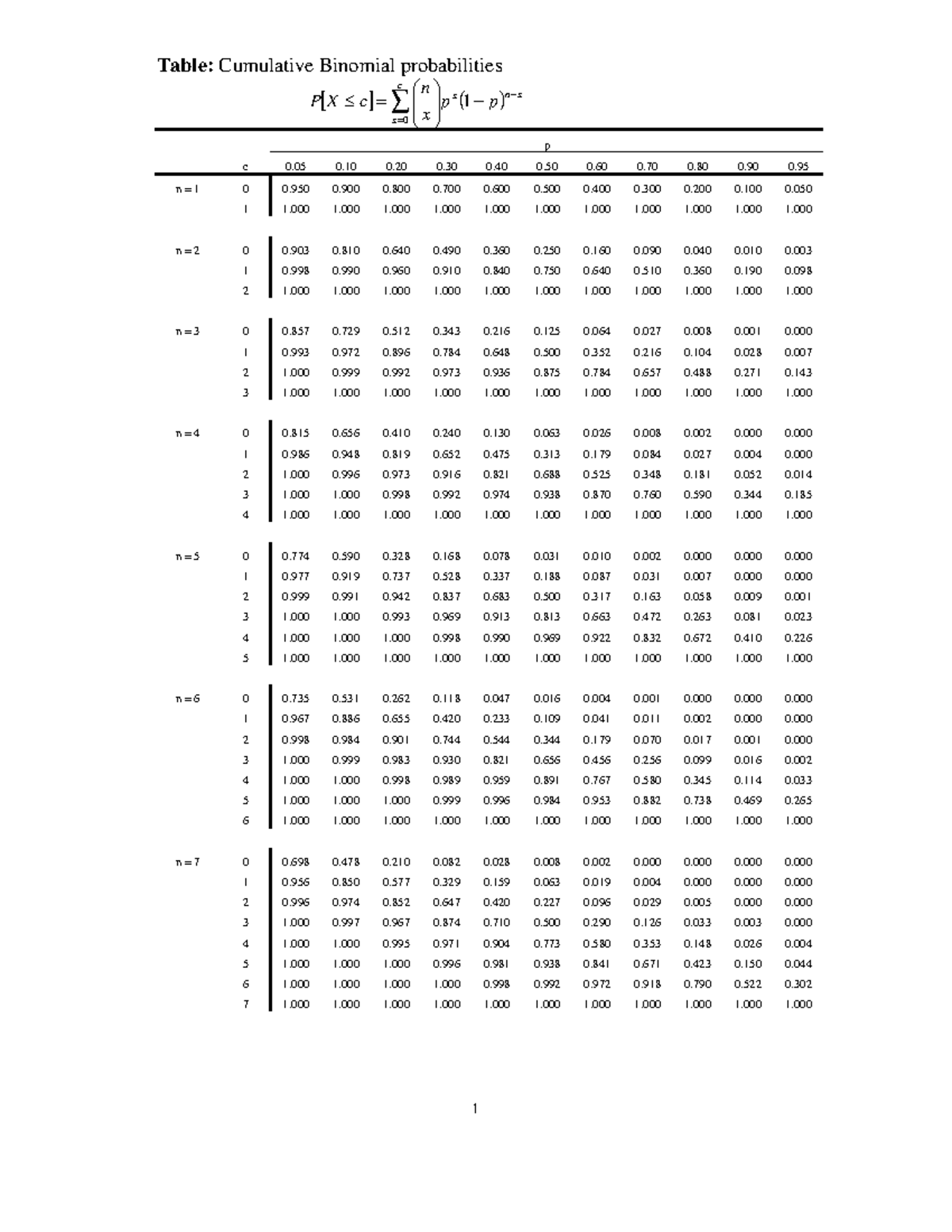

Understanding probability distributions is fundamental in statistics and data analysis. One of the most widely used distributions is the Binomial Distribution, which describes the number of successes in a fixed number of independent Bernoulli trials with the same probability of success. To effectively work with the Binomial Distribution, it is essential to have a solid grasp of the Binomial Distribution Table. This table provides the probabilities of different outcomes in a binomial experiment, making it a valuable tool for statisticians and data analysts.
What is a Binomial Distribution?
The Binomial Distribution is a discrete probability distribution that models the number of successes in a fixed number of independent trials, where each trial has the same probability of success. It is characterized by two parameters:
- n: The number of trials.
- p: The probability of success in each trial.
The probability mass function of a binomial distribution is given by:
P(X = k) = (n choose k) * p^k * (1-p)^(n-k)
where (n choose k) is the binomial coefficient, which represents the number of ways to choose k successes out of n trials.
Understanding the Binomial Distribution Table
The Binomial Distribution Table is a comprehensive tool that lists the probabilities of different outcomes for various values of n and p. This table is particularly useful for quickly looking up the probabilities of specific numbers of successes in a binomial experiment. The table typically includes:
- The number of trials (n).
- The probability of success (p).
- The number of successes (k).
- The corresponding probability P(X = k).
For example, if you have 5 trials (n = 5) and the probability of success in each trial is 0.3 (p = 0.3), the Binomial Distribution Table will show the probabilities of getting 0, 1, 2, 3, 4, or 5 successes.
How to Use the Binomial Distribution Table
Using the Binomial Distribution Table involves a few straightforward steps. Here’s a step-by-step guide:
- Identify the parameters: Determine the number of trials (n) and the probability of success (p) for your experiment.
- Locate the table: Find the Binomial Distribution Table that corresponds to your values of n and p.
- Look up the probabilities: For each possible number of successes (k), find the corresponding probability P(X = k) in the table.
- Interpret the results: Use the probabilities to make inferences about your experiment.
For instance, if you are conducting a survey with 10 questions (n = 10) and each question has a 0.6 probability of being answered correctly (p = 0.6), you can use the Binomial Distribution Table to find the probability of getting exactly 7 correct answers.
Example of a Binomial Distribution Table
Below is an example of a Binomial Distribution Table for n = 5 and p = 0.3:
| Number of Successes (k) | Probability P(X = k) |
|---|---|
| 0 | 0.237 |
| 1 | 0.396 |
| 2 | 0.263 |
| 3 | 0.081 |
| 4 | 0.018 |
| 5 | 0.002 |
This table shows the probabilities of getting 0, 1, 2, 3, 4, or 5 successes in 5 trials with a 0.3 probability of success in each trial.
Applications of the Binomial Distribution Table
The Binomial Distribution Table has numerous applications in various fields, including:
- Quality Control: In manufacturing, the table can be used to determine the probability of a certain number of defective items in a batch.
- Market Research: It helps in predicting the number of respondents who will give a particular answer in a survey.
- Medical Studies: The table can be used to calculate the probability of a certain number of patients responding positively to a treatment.
- Educational Testing: It aids in determining the likelihood of students scoring a specific number of correct answers on a test.
By using the Binomial Distribution Table, professionals can make informed decisions based on probabilistic outcomes.
Calculating Binomial Probabilities Without a Table
While the Binomial Distribution Table is a convenient tool, it is not always available or may not cover all possible values of n and p. In such cases, you can calculate binomial probabilities using the binomial probability formula:
P(X = k) = (n choose k) * p^k * (1-p)^(n-k)
Here’s how to calculate the probability of getting exactly 3 successes in 5 trials with a 0.3 probability of success:
- Calculate the binomial coefficient (n choose k): (5 choose 3) = 5! / (3! * (5-3)!) = 10
- Calculate p^k: 0.3^3 = 0.027
- Calculate (1-p)^(n-k): (1-0.3)^(5-3) = 0.7^2 = 0.49
- Multiply the results: 10 * 0.027 * 0.49 = 0.1323
Therefore, the probability of getting exactly 3 successes in 5 trials with a 0.3 probability of success is approximately 0.1323.
📝 Note: When calculating binomial probabilities manually, ensure that your calculations are precise to avoid errors in your results.
Common Misconceptions About the Binomial Distribution
There are several common misconceptions about the Binomial Distribution that can lead to errors in analysis. Some of these include:
- Assuming Independence: The trials must be independent for the Binomial Distribution to apply. If the trials are not independent, the distribution may not be valid.
- Fixed Probability of Success: The probability of success (p) must be the same for each trial. If p varies, the Binomial Distribution is not applicable.
- Discrete Outcomes: The Binomial Distribution is for discrete outcomes (success or failure). It cannot be used for continuous data.
Understanding these misconceptions can help you avoid common pitfalls when working with the Binomial Distribution.
Advanced Topics in Binomial Distribution
For those looking to delve deeper into the Binomial Distribution, there are several advanced topics to explore:
- Cumulative Probabilities: Calculating the probability of getting k or fewer successes.
- Confidence Intervals: Estimating the range within which the true probability of success lies.
- Hypothesis Testing: Using the Binomial Distribution to test hypotheses about the probability of success.
- Simulation: Using computer simulations to model binomial experiments and analyze their outcomes.
These advanced topics can provide a more comprehensive understanding of the Binomial Distribution and its applications.
In conclusion, the Binomial Distribution Table is an invaluable tool for anyone working with binomial experiments. It provides quick and accurate probabilities for different outcomes, making it easier to analyze and interpret data. By understanding how to use the Binomial Distribution Table and the underlying principles of the Binomial Distribution, you can make more informed decisions in various fields, from quality control to market research. Whether you are a student, a researcher, or a professional, mastering the Binomial Distribution Table will enhance your analytical skills and improve your ability to work with probabilistic data.
Related Terms:
- binomial distribution formula
- binomial distribution table excel
- binomial distribution table n 20
- binomial distribution graph
- binomial distribution table n 50
- probability distribution table